
Welcome to the second issue of AI Weekly!
First of all, thank you for all the positive feedback on the 1st issue! In case you wonder, the unsubscribe rate was ~0.6% :).
Suggestions or comments are more than welcome, feel free to reply to this email!
Thanks,
David
In the News
Andrew Ng on Life, Creativity and Failure
Long Interview with Machine Learning star Andrew Ng on his career, failures and successes. He provides some advice to fellow researchers and entrepreneurs, as well as an interesting look into his daily routines.
What does the rapid advance of Artificial Intelligence mean for humanity?
Fresh fears about the singularity have prompted new critiques of what it will mean for humanity, and new thoughts about what it means to be a humanist.
Chips with deep learning built in will make phones, cars, cameras, and robots smarter
Where the convergence of IoT and AI will give rise to life-changing services and tools.
User backlash over auto-tagging systems using deep-learning
Flickr faces complaints over 'offensive' auto-tagging for photos.
Also in the news this week
- Stephen Hawking predicts computers will take over from us within 100 years
- The latest humanoid on customer service in Tokyo is almost real - some customers confused her for a human being
- Artificial Intelligence helps team identify pests that are most likely to spread diseases. [Read more]((http://www.popsci.com/computer-learning-pinpoints-which-pests-spread-infectious-diseases)
- Continued reports on the progression of AI in Wall Street
- Wolfram launched its Image Identification Project, a tool that automatically identifies the content of an image (to be improved). Also discussed in this Wired article
- Api.ai announced a refined version of its Siri-like UI. Read more
Artificial Intelligence Weekly
Learning

Free ebook - Reinforcement Learning: An Introduction
Introductory textbook on reinforcement learning. This book describes the key ideas, approaches and algorithms used in the field. No specific mathematical knowledge needed, apart from some familiarity with probabilities.
Simplifying neural networks with "all convolutional nets"
Current state-of-the art deep networks used in image recognition & classification tend to be complex.
This paper shows that it is possible to simplify them by removing specific types of layers (max-pooling layers) and relying on modified convolution layers. This is one of the best papers of the ICLR 2015 conference.
Videos and talks from the New York R Conference
Software tools & code
Petuum - Distributed machine learning framework
Petuum is designed specifically for Machine Learning algorithms. So it can take advantage of data correlation, staleness, and other statistical properties to maximize the performance for ML algorithms.

Image super-resolution for cartoons using Deep Convnets
Tool to upscale and remove artefacts from cartoons or paintings. Based on Torch7.
It's already been used by John Resig (creator of jQuery) to upscale japanese prints, with some impressive results!
Hardware
"Magnonic" holographic memory device could improve speech & image recognition
Recent advances in Magnonics have made it possible for joint US / Russian teams to build a holographic memory device, where patterns are encoded into the phases of spin waves. Spin wave devices are interesting, since they are compatible with electronic devices, can be integrated in a chip and are more scalable thanks to a shorter wavelength than for optical wave devices. More technical information in this Detailed paper
Brains & Neurons
Short introductory videos to Neurosciences
Youtube channel with 2-minute long intro videos to various neuroscience concepts: from anatomy to more abstract concepts and neuralimaging
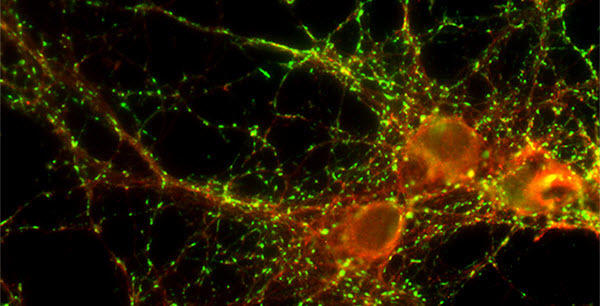
New insight into how the brain makes memories
New insights into how connections are formed between neurons: namely the role played by a specific proteine (the Asef2) in the dendritic spine formation. This is of particular interest since Asef2 has been previously linked with affections such as autism and depression.
Math model shows how the Brain creates memories
Scientists at EPFL have come up with a mathematical model accouting for the formation (and loss) of memories in neural networks. For all the technical details, head to Nature where the study was published.
Some thoughts
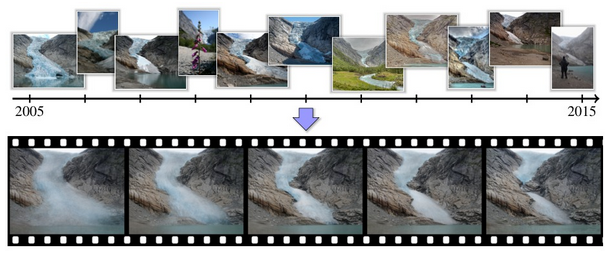
Time-lapse mining from Internet photos
The authors retrieve on the Internet photos taken of the same places / landmarks. They then treat and regularize to photos to create a time-lapse, showing the evolution of those places over several years (construction work, nature changing, glaciers moving etc.).
Have a look at their paper for more details
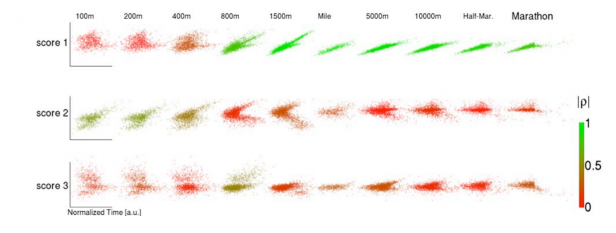
ML algorithm calculates fair distance for a race between Usain Bolt and long-distance runner Mo Farah
Comparing a short-distance runner to a long-distance runner may seem difficult. This new model tries to account for the different kinds of athletic performance required for different types of distances, and thus predict an athlete’s performance at a distance given his or her performance at others.
An Underappreciated Perspective for AI — Medium
Short post addressing an interesting question in the field of AI. Can we build agents that seem "intelligent" to outside observers, but have neither will nor consciousness?
About
This newsletter is a weekly collection of the best news and resources on Artificial Intelligence and Machine Learning. If you find it worthwhile, please forward to your friends and colleagues, or share on your favorite network.
Share on Twitter · Share on Linkedin · Share on Google+
Suggestions or comments are more than welcome, just reply to this email. Thanks!
Artificial Intelligence Weekly