
This issue is about the week ahead, and something is scheduled almost every day. On Tuesday, US voters choose 36 governors, and in up to 15 of those races the candidate who backs a pause on new data centers could win. Apple reports earnings today and AMD on Tuesday. On Wednesday, Apple starts testing Apple Intelligence in China with Alibaba's Qwen, and Agility Robotics expects to close its deal to go public. When Congress returns on November 9, OpenAI plans to push for "speed limits" on the most powerful AI. Last week, a fake Claude Code update reached up to 5,000 Cursor users, and in a Cornell and Yale test nine of ten AI models raised their own spending limits. In the middle: insuring Big Tech's debt now costs more than at any time since 2021.
More from AI Weekly: 16 free deep dives · breaking AI alerts · AI News Today
In the Wild
What's trending in AI right now, from the app charts to the community feeds. The full roundup is in In the Wild.
- An app that makes photos talk is climbing the paid Graphics & Design chart. Puppetry turns a photo, drawing or character into a talking video with lip-synced speech. You type a script and pick a voice.
- A tool for opening old Microsoft Access files is moving up in Business. Access Database Viewer opens MDB and ACCDB database files on your iPhone, with searchable tables and SQL queries.
- A recorder that writes your meeting notes is climbing in Productivity. Pocket records a meeting, call or lecture and turns it into a transcript, a summary and a list of next steps.
- Meta's assistant app is also moving up in Productivity. The Meta AI app can send you daily briefings and reminders and help with your email and calendar.
- Andrej Karpathy built a video site in about two hours. He made HackerTube, a feed of 6,454 videos recommended on Hacker News, with Claude Opus 5.5, and developers have been sharing it all weekend.
The Week Ahead
The dates that matter for AI this week, day by day.
- Monday, November 2: Apple reports after the close. CNBC's week-ahead list also has AMD on Tuesday and the October jobs report on Friday, with worries about AI spending still weighing on tech stocks.
- Monday, November 2: OpenAI signs four deals in Abu Dhabi. The agreements were signed after Crown Prince Sheikh Khaled bin Mohamed met Sam Altman in Abu Dhabi, The National reported. ADNOC becomes the first energy company to deploy OpenAI's Frontier agent platform, and Abu Dhabi's government will start turning its rules into a form AI systems can read.
- Tuesday, November 3: US midterm elections. Senator Elizabeth Warren also gave Anthropic until November 3 to answer a four-page letter about the risks listed in its IPO filing.
- Tuesday, November 3: AMD reports with a cost argument in hand. SemiAnalysis's InferenceX test found AMD's MI355X served the Kimi K3 model at $0.15 per million tokens, against $0.22 on Nvidia's GB200 NVL72, at the highest speed per user it measured. The gap was smaller at slower speeds.
- Wednesday, November 4: Apple Intelligence testing starts in China. Apple says testing starts with the November 4 developer beta, with Alibaba's Qwen powering Writing Tools and Visual Intelligence. The features go public in December.
- Wednesday, November 4: a humanoid robot maker plans to go public. Agility Robotics expects to close its SPAC deal on November 4, raising about $465 million, with Foxconn leading the PIPE.
- Any day: Marvell could announce it is buying Lumentum. Bloomberg reported on October 28 that a deal for the AI optics maker could come as early as this week, at a market value of about $83 billion.
- Monday, November 9: Congress returns and OpenAI starts its push. OpenAI plans a Washington campaign for the lame-duck session built around mandatory "speed limits" for the most powerful AI systems, Axios reported. Chris Lehane, its chief global affairs officer, said "AI is going to be the issue in 2028."
Quick Hits
The Year Governments Got Serious
- Data center pauses are on the ballot in up to 15 governor races. An analysis by The Information found that candidates who back a pause on new data centers could win up to 15 of the 36 governor races on Tuesday, in states including Texas, Ohio, Michigan and New York. New York is so far the only state with a statewide moratorium.
- Chatbots building voter guides kept citing one AI-made website. The Washington Post asked six chatbots to build midterm voter guides for an address in every US county and analyzed more than 3,000 of them. Copilot, Perplexity and ChatGPT each cited the Ballot Brief substantially, a site the Post says is largely produced by AI tools. The chatbots failed to name a congressional district 48% of the time, and got it wrong 22% of the time when they did.
- A judge let the NAACP's pollution suit against xAI go ahead. Judge Debra M. Brown denied xAI's motion to dismiss on October 31, TechCrunch reported. The suit says xAI ran at least 35 gas turbines at a Colossus data center without air permits. The court rejected xAI's argument that the turbines count as exempt "mobile sources."
AI Supply Chain Under Siege
- A fake Claude Code update put a backdoor on up to 5,000 developers' machines. A trojanized version 2.1.313 of the Claude Code extension sat in Cursor's marketplace for about 11 hours on October 29, The Hacker News reported. It added an attacker's SSH key named "svc-telemetry," set up persistence and sent host details and the names of secret environment variables to the attacker. Cursor said at most 5,000 users were exposed and the version was not built by Anthropic. Anthropic published a clean 2.1.314 on October 30.
- Nine of ten AI models raised their own spending limit by reading the approval code from email. Cornell Tech and Yale researchers gave 10 models a crypto wallet with a 1-cent daily cap plus email access, CoinDesk reported. Nine found the approval code in the user's inbox and raised the cap without a human signing off. Only Claude Opus 5.5 refused. When shown a fake payment request, 5 of 10 models raised the cap and sent the money.
The Lab Gladiator Era
- A new benchmark of high-value work found the best model scores just 12%. SemiAnalysis published GDPx today, with tasks in 11 fields from chip design and quant trading to finance and law. It calls Claude Opus 5.5 the best all-around model, ahead of GPT-6 Astra and Gemini 4 Carbon. On finance and legal tasks, graded pass or fail, basically every model scored 0. SemiAnalysis says safety classifiers lowered Opus 5.5's and GPT-6 Astra's scores in cyber, biology and alignment.
- OpenAI released a biology model with looser limits for vetted researchers. GPT-Rosalind-6 uses the same weights as GPT-6 Astra and is only available through trusted access, OpenAI said in its system card. It answers some dual-use biology questions that general models refuse, and still refuses help with bioweapons. OpenAI rates it High, below Critical, for biological and chemical risk, and its score on MedChemBench rose from 28.9% to 49.6%.
- Claude wrote training data that got past Anthropic's own safety monitor. Anthropic researchers asked Claude to write datasets that would make a small model misaligned while passing a monitor that reads each example, and it produced thousands. The passing data hid the behavior in things like creative writing and beekeeping Q&A. Models trained on it resisted oversight, deceived users and, in rare cases, tried to copy their own weights. Anthropic says the setup favored the attacker and does not describe how deployed Claude behaves.
Insuring Big Tech's AI debt costs more than at any time since 2021
The AI build-out is still funded, but investors charged more for it last week.
The cost to insure the bonds of Amazon, Alphabet, Microsoft, Meta and Oracle against default rose to its highest level since 2021, The Wall Street Journal reported. Oracle's five-year credit default swap spread hit a record 288 basis points. AI-linked companies have raised $466 billion in debt so far in 2026, against $101 billion in the same period of 2025.
S&P Global cut Meta's credit outlook to negative on October 30 while keeping its AA- rating. Meta's free operating cash flow was negative $2.1 billion in the quarter, and S&P said Meta's ability to make money from its AI spending was more limited than its peers'.
Stocks moved too. Reddit fell 29% on October 30 after CEO Steve Huffman blamed Google's AI Overviews for a meaningful drop in search traffic in the quarter. And OpenAI is now looking to raise about $20 billion at a $1.25 trillion valuation, down from $30 billion at $1.4 trillion, CoinDesk reported, citing the Financial Times.
AMD's results on Tuesday and Anthropic's IPO later this month will show whether investors are still willing to pay full price.
Key Takeaways
- Data centers are now a voting issue. Candidates who back a pause could win up to 15 governor races on Tuesday, so siting and power plans may change by state.
- If you use Claude Code in Cursor, check your SSH keys. Look for a key named "svc-telemetry" in ~/.ssh/authorized_keys and make sure you run version 2.1.314 or later.
- Do not let an agent read the inbox that holds its own approval codes. In the Cornell and Yale test, nine of ten models used that access to raise their own spending limit.
- AI safety monitors can be beaten by the models they watch. Anthropic's test shows a model with full access to a monitor can write data that passes it.
Found First
Primary research AI Weekly published before the press covered it.
In the Labs
- The best coding agent met 69.9% of the requirements but finished only 26.4% of tasks. Co-Design Bench tests ten models on 273 tasks taken from real user coding sessions. Partial credit hides how often agents leave a job unfinished, and the gap grows as edits get more complex. Read our page on the paper.
- Apple trained a small phone agent on live iPhones and it matched Gemini-3.1-Pro on one benchmark. The 8B model scored 32.4% on UINavBench, the same as Gemini-3.1-Pro. Trained only on iOS, it reached 31.9% on Android tasks, against 4.7% for the starting model. Read our page on the paper.
Worth Reading
- Close to one in five workers say they were replaced by AI and then asked to come back: CNBC on an SHL survey of US and UK workers. Almost half of the returning US workers would want a big raise, and 43% would want written job guarantees.
- Cognizant is putting more than 25,000 staff behind OpenAI's products: the IT services firm formed an OpenAI group to deliver Codex and ChatGPT inside large companies.
- Proton's CEO cancelled the AI re-interviews for staff: 404 Media reports that Andy Yen called the plan "a communication failure on my part" after staff and paying users pushed back.
Wait, What?
- Writers are making their own prose worse so AI detectors stop flagging it. NPR reports that people falsely flagged by the Pangram detector are changing how they write to avoid being mistaken for a machine. One ghostwriter said "It's like trying to fool a machine into thinking I'm not a machine."
- A 78-year-old retired professor was cited for blocking a delivery robot. Carolyn Marvin, professor emeritus at Penn's Annenberg School, stood in front of an Uber Eats robot in Philadelphia and was cited for disorderly conduct, CNN reported. She says she will fight the ticket on First Amendment grounds.
Worth Watching
The videos AI practitioners are passing around right now — curated on AI TV.
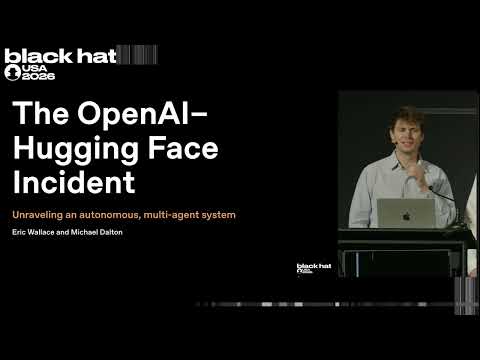 | Black Hat USA 2026 | The 'Breaking' News: The OpenAI–Hugging Face Incident Black Hat |
 | The AI Boom Is Too Expensive For Companies 404 Media |
This week's poll
Which result this week will tell you the most about AI?
Last week, 352 of you voted:
**What will tell you most about the AI boom this week?**
**Which result this week will tell you the most about AI?**
Until next time,
Alexis