Regulators picked a word for AI this week, and the word is systemic. Career Treasury analysts concluded the boom is now too entrenched to unwind quietly: a downturn would ripple through stocks, private credit, data-center debt and utilities. The ECB gave every significant European bank until October 31 to prove it can take an AI-powered punch, and the UK put AWS, Google Cloud, Microsoft and Oracle under the supervision reserved for firms that can break the financial system. The rest of the issue is the same entrenchment at closer range: Meta wiring cameras and face recognition into the glasses on your face, Big Tech rewriting its story about your job, and the first audits of what AI dependence is doing to students, doctors and governments. One story, four layers: the money, the devices, the jobs, the minds.
Sponsor
LLM testing is not enough for AI agents.
Agents take actions, use tools, follow policies, and interact with real workflows. Spec27 helps teams validate behaviour against reusable specs, not just isolated prompt outputs.In the Wild
What's trending in AI right now, from the app charts to the community feeds; a reminder of how far into daily life this stuff already reaches. Full roundup in today's In the Wild.
- Everyone is maxing out GPT-5.6 at once. Demand after the Codex and ChatGPT Work launches was heavy enough that OpenAI temporarily lifted the five-hour usage cap on GPT-5.6 Sol for Plus, Pro and Business plans. Weekly limits still apply, so pace yourself. (BleepingComputer)
- A deepfake got caught by its own watermark. A fake photo of Sen. Mitch McConnell in a hospital bed spread across Reddit and X, and Snopes debunked it using Google's SynthID detector, an early high-profile win for the invisible-watermark system. (TechCrunch)
- Christopher Nolan is a trending AI search. His comments on AI and filmmaking are one of the UK's top AI-related searches this week, as the Odyssey rollout keeps the debate about AI video in theaters. (The Guardian)
- Manus is climbing the charts mid-tug-of-war. The do-it-for-you agent app moved up the US productivity rankings the same week Tencent led a consortium to unwind Meta's $2 billion acquisition of it. Worth knowing who owns your agent. (FT)
- Site owners got an AI-bot switchboard. Cloudflare now lets sites allow or block AI crawlers by category, separating search, training and agent traffic. The scraping debate just became a settings page. (Cloudflare)
Quick Hits
The Year Governments Got Serious
The money layer. What "systemic" means when regulators say it: designations and deadlines, in four jurisdictions, in seven days.
- Career Treasury analysts wrote a draft report calling the AI market a systemic risk to the US financial system, finding AI firms more deeply entrenched in the economy than their dot-com predecessors and warning a downturn would ripple through stock markets, private credit, data-center financiers, cloud providers, chipmakers and utilities. The report, prepared for Secretary Bessent and Fed Chair Warsh, has sat unapproved for weeks; a spokesperson dismissed it as unvetted and restated that AI "will be a key driver of America's new Golden Age."
- The ESRB formally warned that frontier AI models could strain the financial system's cyber resilience, concluding that in the short to medium term the advantage goes to attackers, who can discover vulnerabilities and execute attacks with more speed, scale and sophistication. A formal ESRB warning is a rare instrument, and this one names frontier AI directly.
- The ECB wrote to the CEO of every significant bank it supervises about AI-enabled cyber threats. Supervisory Board chair Claudia Buch's letter warns that emerging AI models can identify vulnerabilities and generate functioning exploits at unprecedented speed, and requires each bank to submit a concrete action plan, with measures, resources and responsibilities, to its supervisory team by October 31, 2026.
- The UK began supervising AWS, Google Cloud, Microsoft and Oracle as Critical Third Parties to the financial system as of today, July 13. It is the first time the Bank of England, PRA and FCA jointly oversee tech suppliers, a designation built for firms whose failure could take parts of the financial system down with them. The AI stack's cloud layer is now regulated infrastructure.
The Glasses Are Recording
The device layer. The same entrenchment at arm's length: cameras and face recognition shipping toward your face, by default.
- Wired found dormant facial-recognition code, internally called NameTag, inside Meta's AI app, built to convert faces captured by Meta's smart glasses into biometric identifiers stored on-device and matched against new scans. After Wired's discovery, Meta shipped an update removing the code and called it a pilot with "no final decision" made. The cloud layer got regulators this week; the code on your phone still relies on journalists.
- Meta is testing prototype glasses that continuously collect audio and take photos every few seconds for an AI memory feature, per FT sources cited by TechCrunch, in the same week it announced the camera will disable itself if the recording LED is tampered with. Meta concedes the safeguard exists because owners were already covering the light.
The AI Capex Tax
The labor layer. Payroll plans are being rewritten around AI, whichever story the CEOs are telling this quarter.
- Big Tech has suddenly flipped on the AI jobs wipeout scenario, the WSJ reports. Sam Altman now says the industry was "pretty wrong on the social and economic implications," Dario Amodei has moved from warning AI could erase half of entry-level roles to a vastly-more-productive-workers framing, and the share of CEOs expecting AI to cut headcount fell from 46% to 20% in an EY-Parthenon poll.
- TCS plans a bench of up to 8,900 forward-deployed AI engineers and its first major AI acquisitions, betting that the agent era grows outsourcing instead of gutting it. The $315 billion Indian IT giant is putting real headcount behind the claim the week its Western peers softened their layoff talk.
The Cognitive Audit
The deepest layer of the dependency is cognition itself, and its first real audits came back this week. Institutions did not like the results. At Brown, an economics professor gave his class an in-person final after a suspiciously perfect take-home midterm: the average fell from 96% to 48.6%, 18 of 86 students dropped the course, and he is giving the rest "a chance to prove me wrong." In Nature, early studies now show that reliance on AI tools measurably degrades the abilities of physicians and software engineers, the people using them most. And South Africa withdrew its draft national AI policy 17 days after publication when a civil-rights group found at least 6 of its 67 cited sources were AI fabrications, joining Deloitte's refunded reports in Australia and Canada and the EU cyber agency's 26 hallucinated footnotes.
The pattern matches the top of this issue. Once a dependency turns systemic, institutions stop debating it and start managing it: in-person exams, procurement clauses that force AI disclosure, action plans due to supervisors by a date certain. The classroom and the central bank made the same move this week.
Key Takeaways
- Regulators moved from warning about AI to supervising it in a single week: a US Treasury draft, a formal ESRB warning, an ECB action-plan deadline of October 31, and a UK designation that treats the cloud layer like critical financial infrastructure.
- Meta's wearable strategy keeps shipping surveillance capabilities by default and retiring them only on discovery. Wired's NameTag find and the always-on prototype test are the same pattern twice in one week.
- The AI-jobs message from the top turned optimistic in unison. Watch the EY poll number, and watch who is hiring deployment engineers while saying it.
- The dependency now reaches cognition: AI-reliant students, physicians and policy shops all failed their first audits. The response, in classrooms as in central banks, is risk management: checks, disclosures and deadlines instead of faith.
Worth Reading
- Anthropic reports evidence of a "global workspace" inside Claude: a small set of internal patterns that holds a few dozen concepts, supports multi-step reasoning, and can be read back by the model. Anthropic is explicit that this is not evidence of machine experience. A rare look inside the machinery everything above now depends on. (Anthropic)
- KronQ makes 2-bit quantization of LLaMA-3-70B work, hitting 7.93 perplexity where GPTQ collapses past 2,000. Submitted to COLM 2026, and as far as we can find, not covered anywhere yet. (arXiv)
- AI coding tools are overwhelming open-source maintainers, an FT feature on productivity gains for tool users externalized as review burden on volunteers. The dependency's maintenance bill, arriving at open-source first. (FT)
- Sequoia's David Cahn now puts the revenue needed to justify 2026's $1.5 trillion of AI infrastructure at $3 trillion, and calls that figure understated. (TechCrunch)
- The Register on why the BIS and Oracle's own SEC filings are the newest bubble warnings, including Oracle's disclosure that OpenAI may not be able to pay for the capacity it committed to. (The Register)
Wait, What?
- Every major chatbot writes "It's not X, it's Y," and nobody fully knows why. The Atlantic investigates "negative parallelism", the construction that has overtaken the em dash as the most recognizable AI writing fingerprint. Models from every lab converge on it independently, and the mechanism behind the convergence is still an open question. A fitting closer for this issue: the clearest measure of how deep AI already runs through what we read is a tic that nobody can explain, sitting in a billion documents. (The Atlantic)
Worth Watching
The videos AI practitioners are passing around right now — curated on AI TV.
 | How Brands Use Reddit to Poison AI Search 404 Media |
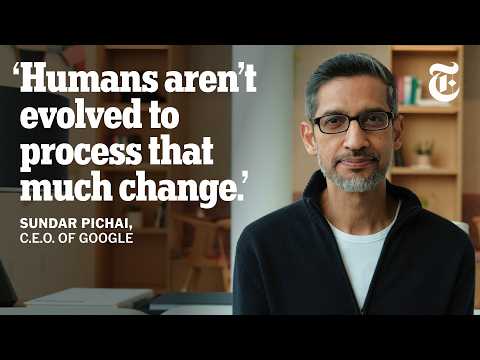 | Sundar Pichai on A.I. Backlash, the Future of Work and Google’s Next Era Hard Fork |
This week's poll
Regulators called it systemic risk this week. Where is the AI trade 12 months from now?
Last week, 523 of you voted:
**We're thinking about a hands-on AI membership, around $30 a month, cancel anytime: prompt, code, and automate your workflow with live practice on real tools, no boring PDFs. Would you join?**
**Regulators called it systemic risk this week. Where is the AI trade 12 months from now?**
Back Wednesday with the regular mix.
Alexis
Sponsor